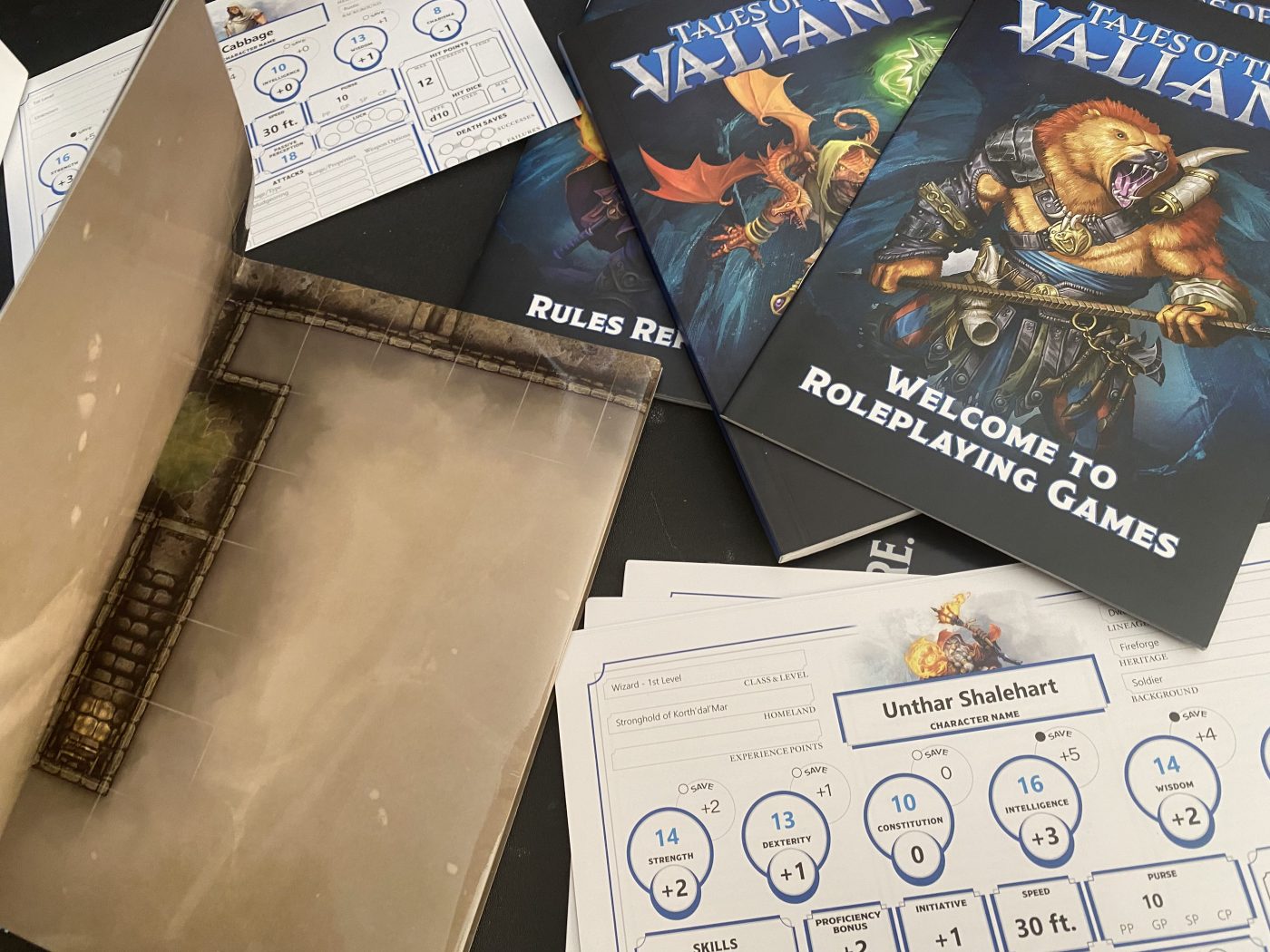
A look at Tales of the Valiant Adventure’s Introductionary adventure along with the start set. I’ll go over some of the Starter Set of Tales of the Valiant, but this does not cover all adventure in the box.
Recently a friend of mine asked me to introduce them to tabletop roleplaying games. I wanted to introduce them with Dungeons and Dragons, as it is arguably the most well-known in it’s popularity. Though I still had a large backlog of other games I wanted to explore. On October 12th 2025, I set up a game of Tales of the Valliant by Kobold Press with its accompanying Starter Set from Steamforged Games.
Tales of the Valiant came out as a response to the Open Game License (OGL) debacle that occurred years ago. Wizards of the Coast, owners of Dungeons and Dragons, had tried to take away a license that allowed creators to use some parts of their game to create their own products for the D&D community. In response, several gaming companies and community creators decided to step away from Dungeons and Dragons, instead creating their own game. Tales of the Valiant was one that came out that is their own take on the d20 system popularized by Dungeons and Dragons.
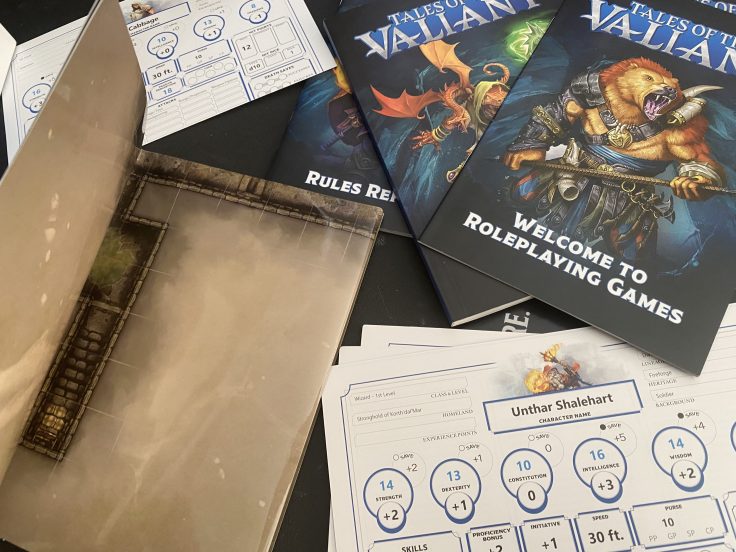
The Starter Set
The starter set, at time of writing, is priced at $44.99 on Steamforged Games Website. The set comes with a set of dice, pregenerated characters, 4 character miniatures, monster tokens, glossy battle maps to be used with the adventures, a small introduction booklet to roleplaying games, two stitch-bound adventure books one that is labeled “Introductory Adventures” and the other is “Advanced Adventures”, and a separate staple bound the Rules Reference book. For the cost, it comes off as a good deal.
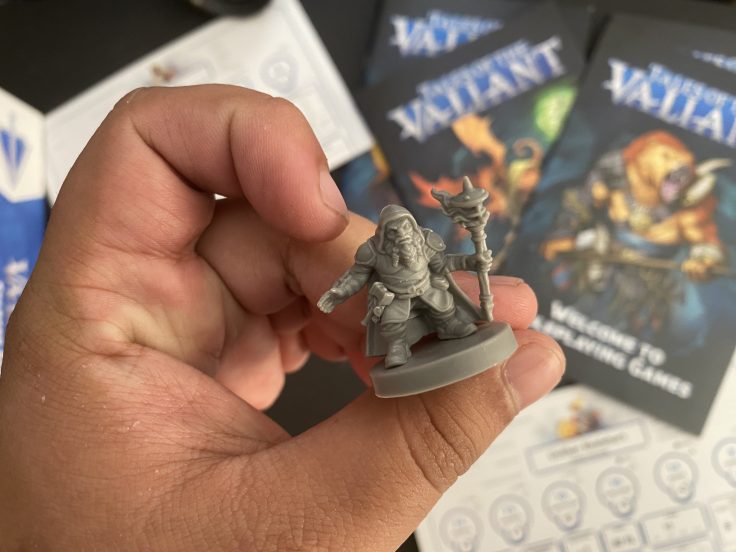
The minis are okay. There’s enough detail to make them stand out at the table. The characters are smartly designed to be different heights with different poses that helps distinguish from each other when placed on the map. Especially when you haven’t painted them. I am not going to comment on how they are when it comes to painting. My experience was using them just in gray scale at the table which worked fine
The character sheets are my biggest issues with the set. The ones in the starter set are printed on glossy decent quality paper with everything printed on both sides. For a game that has numerous character talents and abilities, it is not ideal. One is a 10-99 tax sheet of information while the back is everything you would get during level up, along with explanations on most features, talents, and characters motivations. I notice players tend to focus on one side of a pre-gen and forget the second sheet especially if they are new players. Thankfully Steamforged Games does have the character sheets PDF for free at their website to print at home. However, you may still want to download all the characters from the site as the information feels scattered.
The player playing the wizard looked up from the table “Where’s burning hands spell?” she ask me. The wizard has it listed as something they can do, but it doesn’t say the spell description. I looked through my copy of the character PDF. It wasn’t their on the spell sheet. “Maybe it’s in the rules reference” I say. I took the booklet and quickly scanned the spell. It’s alphabetically organized so it should have been simple to find but it told me that all player spells were found on the character sheet. An old adage I’ve heard is that if it takes longer than 30 secs to find information during the game, trying to make a ruling then and there. Don’t let the game stall. Try to find it afterwards. I’ve played Tales of Valiant before with its quickstart for Free RPG Day. I know the spells are roughly similar to Dungeons and Dragons. We grabbed the Player Handbook for DND that was nearby and used that. After the session, I found the burning hands spell. It’s on Warlock’s spell sheet as a Pact Spell.
The player playing the warlock was one of the newer players and I could see why they may not have mentioned it. They might have thought it wasn’t the same one for the wizard or there was a difference between Pact Spells to Spellbook written spells. It’s on the spell sheet for their Warlock, and it’s under a section that reads Level III. If these spell sheets were supposed to be for around the table, why is only found in the PDF for the warlock? Why isn’t there a separate spell sheet handout, much less why isn’t it just put twice in the rules reference book? The only spells in the reference book are ones that can be found in the adventures via items or scrolls. I love that there is a rules reference book. It’s one of my favorite things to find in a starter set, as I can leave the rules reference on the table for any player to pick it up. I just wish that everything players might want to reference was in there.
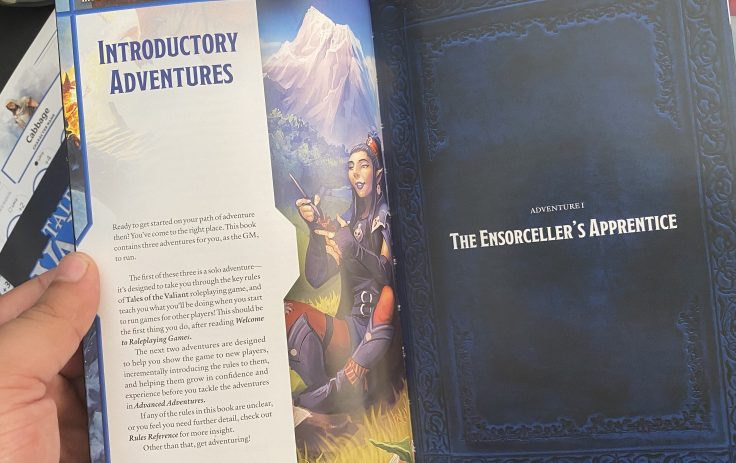
There are five adventures that come in the adventure books. The first adventure is for whoever is running the game. You’ll take the pre-generated character named Cabbage and go through a small linear adventure to learn the game and its mechanics. With having years of game-mastering games similar to Tales of Valiant and the fact I read the rules references first before the adventure book, I did not play through this one. It looked fine. It reminded me of Choose Your Own Adventure books, just simpler.
The rest of the adventures are for the GMs to run at the table. It can be used as a loose narrative framework for a small campaign. They would start at level 1 and go up to level 4. With two players new to the hobby of Role-playing Games, I decided to start with the first adventure.
Thoughts and Advice
Adventure Title: Down the Rabbit Hole
Level: 01
Area: Underground Tunnels
System Created for: TALES OF THE VALIANT
Written by: I’m not entirely sure if the adventures in the books were by a single person or team. There are no credits regarding individual adventures. In the front credits, it states Adventure Design: Oliver Darkshire.
How Long it took to play: 1 4-hour session
Any other resources used to run: None
Battlemaps: Yes, They comes with the starter set
Pregens: Yes, come with the Starter Set.
Spoilers from here on out. You have been warned
Our heroes awaken in a pitch black room. Shaking their heads, they remember being in town before the world started shaking. A sink hole opening beneath the feet. Death all for certain as they fell into the chasm, until a wizard known as Rantipole jumped to use his magic. They crash landed in the tunnels beneath the town, yet safe thanks to the wizard’s protection. Our heroes now have to venture through this tunnel system and make it back into town.
Down the Rabbit Hole is a simple dungeon crawl adventure throughout tunnels beneath a city. It feels akin to a video game’s first tutorial area. It slightly touches upon all the core pillars of a D20 game: exploration, combat, and social interaction. The adventure is written with text boxes placed throughout the book to help new GM’s get used to the different mechanics of Tales of Valiant. It’s written in a way for new mechanics to slowly be introduced as our heroes venture through the dungeon.
The dungeon is a fairly linear 11 room dungeon; with encounters that felt balanced for a full 4-person party of adventurers. These encounters could be avoided with skill use or clever roleplay. For example, characters will have to face a room of busted open sarcophagi with skeletons lying inside them, all ready to rise to fight the intruders. Yet if they all are able to sneak out of the room, then the skeletons lay dominant. There is a sewer tunnel area where rust monsters appear once half of the characters pass through the midpoint. They are just little guys who want a meal of our hero’s metal weapons and armor. They aren’t attacking the heroes. An animal handling roll could give them the information that the characters could out maneuver them with tossing metal between the characters. I like that it is completely possible to get out of the dungeon without touching the combat mechanics. For any new Game-masters, if you have new players, pay attention to how the characters handle the skeletons first. If they seem gung-oh to attack everything at sight, tell them the behavior of the rust monsters. Telegraph their motives as they appear. Put in an old dagger or metal implement on the ground near the players where they first enter, then have that be the first thing the creatures eat. Drop subtle hints at other possibilities solutions. “These creature’s feelers touch the dagger and it starts to turn brown and brittle in front of your eyes. One of their antennae seems to sniff the air and continue to sniff towards you. Do you guys try to figure these things out, try to avoid them or What do you want to do?”
My new players had a lot of fun with this adventure. Me and one of the more experienced players found it fairly standard. For me, I felt there could’ve been more to help new GM’s. It would also help to clarify what’s going in the overall connecting plot.
Throughout the entire adventure, the players kept speculating what was the cause of the sinkhole. Was it the rust monsters and there was some hive that started to weaken the city? Was there something wrong with the city’s infrastructure? WAS IT RANTIPOLE?! While speculation is all good, the adventure itself doesn’t tell the GM why the sinkholes are occurring. That’s explained in the level-4 adventure in the starter set! Knowing why the sinkholes are happening, can let GM’s slowly drip feed the hints for players to change their theories throughout all of their adventures. The adventure doesn’t even tell if certain set pieces are for hints in the connecting story or if they are places where a GM can throw in their own lore.
The section of the sewer tunnel has a small waterfall opening that players can venture through. This is mentioned as beyond the the scope of the adventure and that GMs would have to put their own ideas. Earlier in the adventure, I wish there was a similar footnote about two setpieces. The characters run into a statue with a curse gem and evil writing around the room. While there were notes about who made these, I do not know if these were connected to the sinkholes. It would be nice for a small “feel free to make your own cult or go to this adventure to learn more” . Any GM’s planning to run Down the Rabbit Hole, I would recommend reading all four adventures before running the first. especially if wanting to connect them in a small campaign. As this was a one shot for new players, I did not mind having to create lore about an evil cult on the fly.
Another part that I wish the game had better advice on, was on using Rantipole as a friendly NPCS. Rantipole is with the party this whole adventure, and if not with the party, further behind keeping an eye on them. The way the adventure is written, Rantipole takes a backseat, to the point that he is kind of forgotten about. GM’s, do not be afraid to use Rantipole. I agree he should be in the backseat to avoid stealing the player spotlight, but that doesn’t mean he should be useless. While he has a ton of hit points, he should not be fighting with the party. If the heroes find themselves in danger of death and have used up their short rest, then he may have a potion or two that he can pull out to help them. He is also a great way to keep players on track. If characters are going to venture forward to the unprepared waterfall sections, he could either warn the heroes that he senses a great danger, or better yet, he could point the way out and tell them “Once we get out, restock supplies and Old Rover used to adventure with me back in the day. He knows these sewers like the back of his hand and could draw a sewer map. It’s best you know what you’re getting into” He’s a smart wizard that just has face blindness.
While Rantipole is a wizard, he can’t cast spells with a broken spell-casting focus. A broken wand stops him from getting the player out of the current bind. It felt like pretty weak reasoning to me, and felt like the players were going to have way more questions that I had time for. For my game, I still used Rantipole as the savior wizard, though as he meets the heroes he does have some amnesia. The heroes see him and then a large rock slides to hit him on the back of the head. As he is the main patron for the rest of the campaign adventure, he could just be pretending to forget as a test for the adventurers.
Overall I think Down the Rabbit Hole is an okay adventure. It’s simple enough for new Gamemasters to run, though could use some more advice. I’ve run other introductory adventures that have felt epic and grand. They showcase what type of adventures you can expect at the start. One of my favourite adventures is the Dungeon Crawl Classics. level-0 Sailors on the Starless Sea which had various dangerous and interesting setpieces to show what cool things the player may have to face even at low level. That was a full meal, Down the Rabbit Hole is just a small portion of what RPG adventures can be.
 A Stray Blog
Leave a comment